
The 17th Amendment and How We Lost State Representation in DC
Discover how the 17th Amendment reshaped America’s balance of power, why it was added, and what we can do to restore federalism today.
I’ve touched on the 17th Amendment in the past here on RFP, but it is so critical and has caused such damage to our Republic that I’m having another go at it today.
When the Founding Fathers crafted the Constitution, they intended for the U.S. Senate to be a voice for the “states” in federal government. After all, the original idea was to have balanced control between the states and the federal government, right? But in 1913, the 17th Amendment flipped the script. It replaced state legislatures electing the “State Senators” with direct election of senators by “We the People”. Sounds democratic, right? Yes it does, until you realize this move gutted the states' influence in Washington and shifted the balance of power in ways we’re still fighting today.
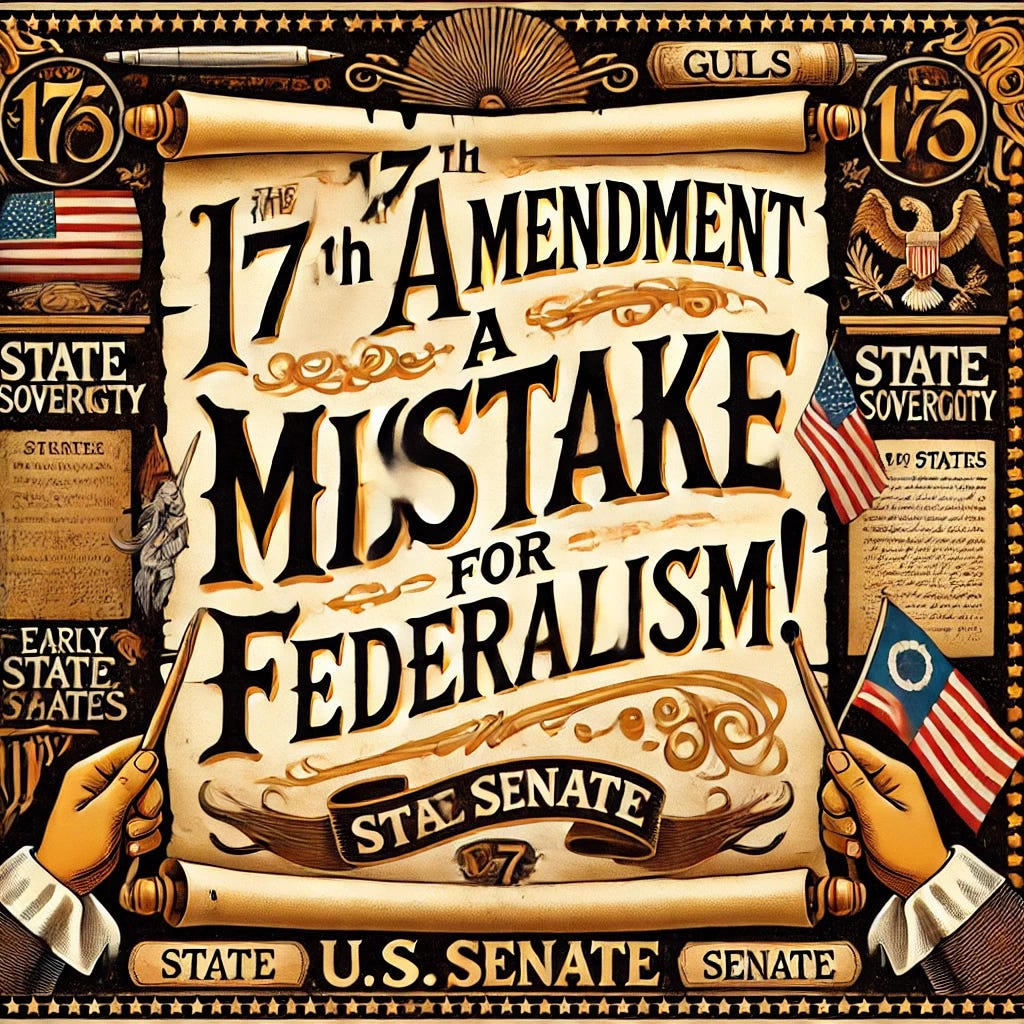
I’m going to break down what the 17th Amendment says, why it came to be and what can be done to restore the original design of our republic.
The 17th Amendment, ratified on April 8, 1913, changed how U.S. Senators are chosen. Originally, Article I, Section 3 of the Constitution gave state legislatures the responsibility to elect senators for their state. This setup ensured that states had a direct say in federal decisions, balancing the people's voice (through the House of Representatives) with the states’ interests (via the Senate). Solid and clearcut way to maintain the balancing act that the founders had worked out.
But the 17th Amendment rewrote this. It mandates that senators are now elected by the people of each state. In short, it turned the Senate into a smaller, elite version of the House, which in my mind accomplished nothing and distorted the balance that the founders sought. Instead of representing their individual state governments, senators now focus on their reelection campaigns, their national party politics, and catering to their big-money donors. NOT the original idea!
You can read the full text of the 17th Amendment here. It’s only 134 words so have a look! Less than 2 minutes to read, no excuses…
So Why Was the 17th Amendment Adopted?
Here’s the backstory: By the late 19th century, critics of the original Senate election process were screaming about corruption, deadlocks, and inefficiency in state legislatures. It wasn’t uncommon for legislators to get bribed by wealthy business interests, leading to “bought” Senate seats. Sometimes, state legislatures couldn’t even agree on a candidate, leaving Senate seats vacant for years. Yes all this was happening even then…
Populists and Progressives saw this as a golden opportunity. They argued that the people—not “corrupt” legislatures—should elect senators. The movement gained steam during the Progressive Era (1890s–1920s), when reformers pushed for more direct democracy. They blamed the state legislatures for failing the public and said direct elections would solve these problems.
But here’s the kicker: This “solution” ignored the bigger issue. Corruption and political gridlock didn’t disappear at all, they just shifted to a different battlefield. Instead of protecting state interests, senators now answer to national party machines, lobbyists, and voters who may not fully understand or prioritize federalism. IMO, most of the population willfully ignores politics in this country for numerous reasons of their own, which is part of the reason we’re in the mess that we are in. I know several personally! And they don’t read RFP, BTW. Sorry, I digress again…
The amendment’s adoption was part of a broader push for Progressivism, which also brought us the income tax (16th Amendment) and Prohibition (18th Amendment). Talk about a mixed bag of nuts that should all be repealed!
How Did the 17th Amendment Change America?
The 17th Amendment sounded like a win for democracy, but it came at a steep cost. Let’s unpack the fallout:
1. States Lost Their Voice in Washington:
Before 1913, senators worked for their state governments. They had a built-in incentive to protect state sovereignty. After the 17th Amendment came to be, states were sidelined. Federal power grew, often at the expense of state authority. Think about it, if states still had a direct say, would we have seen such massive expansions of federal programs and mandates? Personally, I think not!
2. Senate Elections Became Nationalized:
Direct elections made Senate races a magnet for special interests and big money. Instead of focusing on local issues, candidates chase national headlines and appeal to the whims of an uninformed electorate to get elected.
3. The Balance of Federalism Tilted:
Federalism is about balance—between national and state governments. By cutting states out of Senate elections, the 17th Amendment upset this equilibrium. The federal government gained more control, and states became mere administrative units.
What Can Be Done About It?
So, we’re stuck with the 17th Amendment, right? Well, not necessarily. Repealing a constitutional amendment isn’t easy, but it’s not impossible. Here’s what could be done:
1. Advocate for Repeal:
A growing movement calls for the repeal of the 17th Amendment. If enough states push for an Article V Convention via Convention of States, we could undo the damage. This will take immense political will and a lot of grassroots support. Easy? No. Doable, Absolutely Yes! Follow one of the links above to see how you can help!
2. Strengthen State Power Through Legislation:
Even without repeal, states can assert their sovereignty. State legislatures’ could require senators to consult with them on key votes or pass resolutions reminding their senators who they truly represent. Personally, I like this approach, at minimum it gets the Senators on a leash that is controlled by their state. And again, that was the original intent pre-17th. And it would be much easier to accomplish!
3. Educate the Public:
Most people don’t even know what the 17th Amendment is or why it matters. If more Americans understood how it undermines federalism, it would help build momentum for reform. Start with conversations in your community, write to your local representatives, and share resources such as RestoreFirstPrinciples.substack.com.
4. Emphasize Accountability:
While direct elections are here for now, we can push for senators who respect state sovereignty and advocate for policies that restore the original balance of power. To the average citizens this means there is a huge need to Vet candidates very carefully.
The 17th Amendment might have seemed like a good idea in 1913, but over a century later, its flaws are clear. It weakened the states, undermined federalism, and put the Senate on a path that often serves national agendas over local needs. If we want to restore the balance envisioned by the Founders, we must rethink this amendment’s impact and take steps, big and small, toward restoring the principles of our republic.
Just Sayin…
Help Restore First Principles Reach New Subscribers By Clicking The Like Button, Assuming, Of Course, That You Like This Post...
And If You Have a Comment To Make, Please Do So. RFP Is Always Happy To Get A Conversation Going!
Ken, please make sure when you speak of Convention of States, you don' t use constitutional convention. Just use article V convention. The opposition uses the constitutional convention as an argument of the runaway convention trying to say we want to rewrite the constitution. Thank you:)