
What the Framers Actually Built Into Article V
John Dickinson defended the amendment process publicly in 1788. His argument was precise, his language was unambiguous, and it has never been answered.
John Dickinson wrote that in 1788. Not as a wish. Not as an argument for what the Constitution should say. As a statement of what it does say, written by one of the men who helped build it and addressed to the American public during the ratification debates.
The argument being made today against an Article V convention of states is not a new argument. It is the same argument Dickinson was answering when he wrote the Fabius Letters. The names have changed. The objections have not.
The concern is this. A convention of states, once called, cannot be controlled. Delegates arrive with a mandate from their state legislatures, but once assembled they become sovereign deliberative actors. The precedent of 1787 is cited: those delegates were sent to amend the Articles of Confederation and produced an entirely new frame of government instead. If it happened once, the argument goes, it can happen again. The entire Constitution could be opened for revision by a body operating outside the normal checks of the legislative process. The risk is too great. The tool is too dangerous.
That argument is held by serious people, and like it or not, it deserves a serious answer.
Dickinson gave one in 1788. In public and in writing.
The first answer is in the architecture. Dickinson wrote that the Framers “provided for making at any time amendments on the authority of the people, without shaking the stability of the government.”
“Without shaking the stability of the government.” That phrase is load-bearing. Dickinson was not describing a mechanism that could dissolve the constitutional order. He was describing one built specifically to preserve it while correcting it.
Here is where the runaway convention fear misreads the document. A convention called under Article V PROPOSES. It does not ratify. What it proposes then goes to the states for ratification. Three-fourths of the states must approve any amendment before it becomes part of the Constitution. Thirty-eight states. A runaway convention cannot ratify a single word it produces. The states that summoned the convention are the same states that hold the ratification vote. The lock on the door does not disappear because the door has been opened.
The 1787 analogy collapses under examination. The Philadelphia Convention operated under the Articles of Confederation, which required unanimous ratification by all thirteen states. The Framers proposed a new ratification threshold and submitted the document directly to ratifying conventions, bypassing state legislatures entirely. That sequence cannot be repeated under Article V. The process is different. The safeguards are different. The analogy is not an argument. It is a fear wearing the costume of an argument.
(A brief but remarkable aside: the Articles of Confederation that the Philadelphia Convention was charged with amending were themselves principally written by John Dickinson. The National Archives identifies him as the principal writer. The man sent to Philadelphia to build a better framework had written the one being replaced. He did not arrive as a critic. He arrived as the author. Isn’t that a fascinating tidbit of history?)
The second answer is harder to argue with, because it is a single word in a very powerful paragraph.
Dickinson put it plainly in Fabius Letter VIII:
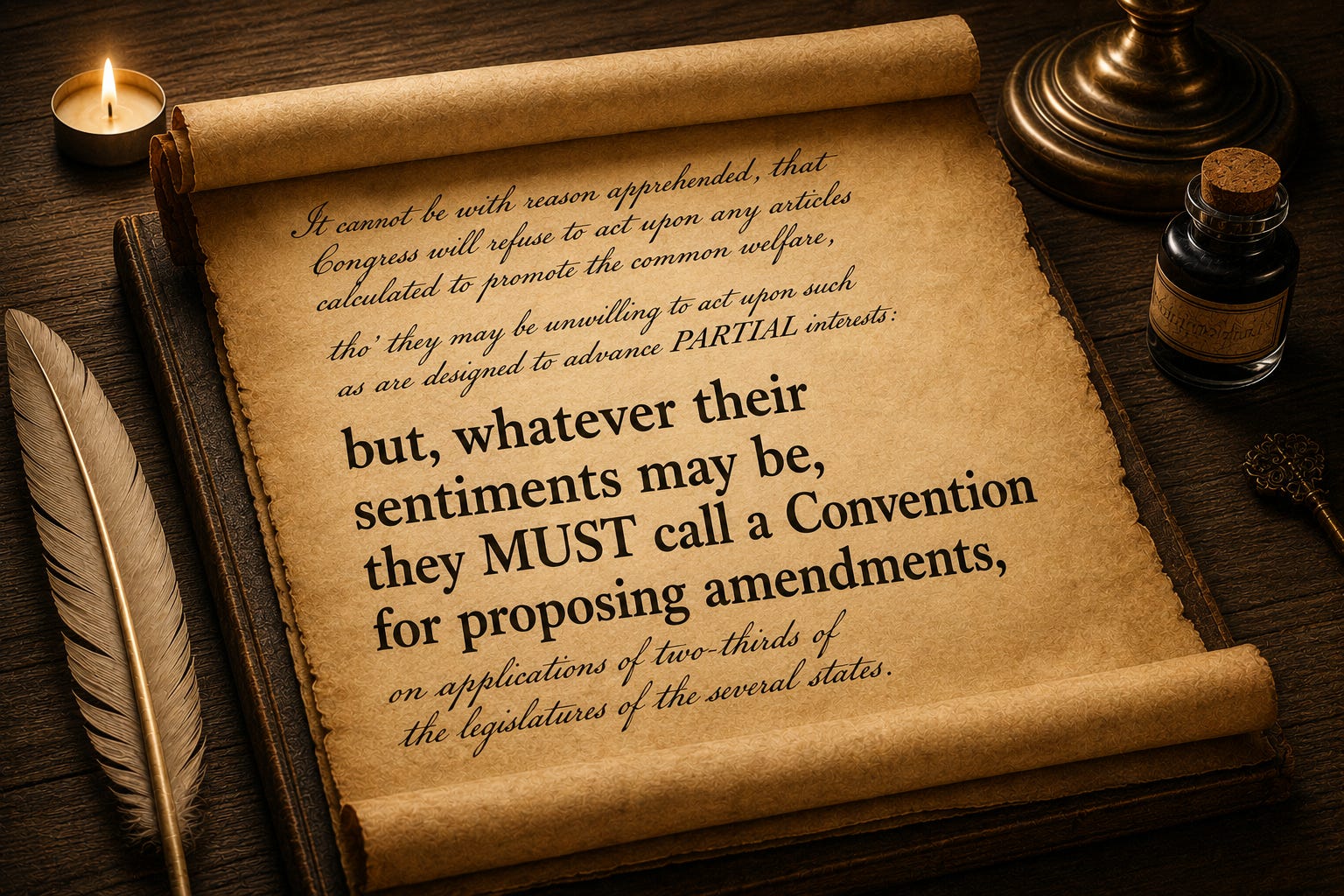
“It cannot be with reason apprehended, that Congress will refuse to act upon any articles calculated to promote the common welfare, tho’ they may be unwilling to act upon such as are designed to advance PARTIAL interests: but, whatever their sentiments may be, they MUST call a Convention for proposing amendments, on applications of two-thirds of the legislatures of the several states.”
I know what some are thinking and the capitalization is his, not mine. Whatever Congress thinks. Whatever Congress wants. The obligation does not bend to congressional sentiment. That is not advocacy. That is the constitutional record.
The anti-convention argument requires reading “must” as “may”. It requires treating a constitutional mandate as a congressional option. It requires believing that the Framers inserted a second pathway for amendment, designed specifically to operate without congressional consent, and then handed Congress the power to ignore it entirely.
Dickinson did not believe that. He wrote the opposite.
(There is something worth noting here. The argument that Congress can pocket thirty-four valid applications and take no action does not protect the Constitution. It eliminates one of its two amendment pathways entirely. That is not constitutional conservatism. That is constitutional amputation.)
Then Dickinson did something that deserves to be read slowly and with great consideration. He turned from the legal argument to the human one.
In plain terms: not everyone opposing the constitutional amendment process is doing so in good faith. Some are using the credibility of sincere, principled skeptics to advance an agenda that has nothing to do with protecting the Constitution and everything to do with ensuring it cannot be used to check accumulated federal power. And Dickinson does not stop there. He tells the good faith skeptic directly what happens if they continue lending their name to that argument. The resulting conflict, he warns, will be beyond the power of even their most capable and virtuous efforts to resolve.
Read him precisely. Dickinson was not attacking every skeptic. He was making a careful distinction between the sincere doubter and the bad faith operator borrowing their credibility. He was asking careful people to examine whose arguments they were amplifying and whose interests those arguments actually served. And he was warning them, with genuine concern, that the cost of getting that wrong is not merely political. It is constitutional.
That warning was written in 1788 and it has not expired. The closing argument is the one Dickinson never stopped making.
The states are not spectators. They are constitutional actors with a documented obligation. Dickinson wrote that “America is, and will be, divided into several sovereign states, each possessing every power proper for governing within its own limits for its own purposes, and also for acting as a member of the union.” State officials who allow federal encroachment to go unanswered, he argued, commit a breach of trust. And if they lose that ground, the verdict was unambiguous: “It will be their own faults if the several states suffer the federal sovereignty to interfere in things of their respective jurisdictions.”
The mechanism exists. The obligation exists. The argument for both was made publicly, in the Founding era, by one of the architects of the document itself.
What Mason, Morris, and Gerry built into the Constitution, and what Dickinson then defended in the pages of American newspapers under the name of a Roman general famous for patient and deliberate resistance, was not designed to sit unused while the government it was meant to correct continued expanding without limit. (This paragraph has been updated, an exceptionally sharp eyed reader noticed a mistake, brought it to my attention and a correction has been made. Thank you Shawn@ The US Constitution | Shawn’s Substack)
He is not finished making that argument. He never was. And now he is waiting on us.
Ken Whaley @ Restore First Principles
You write so much which is not true. The 1787 Convention was not called under the authority of the Articles of Confederation because they had no such authority. It was called under the sovereignty of the individual states.
10 of the states mandated provisions similar to Article 13 of the Articles of Confederation in their delegate commissions. [https://csac.history.wisc.edu/the-constitutional-convention/convention-delegates/] Those instructions specifically required anything produced in the Convention must be ratified by the Continental Congress and legislatures of all 13 states.
Article VII of the new Constitution only required ratification by 9 states, specifically disobeying their limits. In Federalist 40, they admitted and rationalized exceeding their authority.
How you feel Dickinson is responsible for Article V convention in the Constitution is disturbingly departed from reality. George Mason made the declaration that such might be needed and then Mr. Govr. MORRIS & Mr. GERRY moved to amend the article so as to require a Convention on application of 2/3 of the states during the Sep 15, 1787 debate.
It is really sad and offensive that someone purports to represent themselves as an authority but publishes verbatim misinformation of the Constitution re-writers.
Your argument succeeds because it does not rely on modern political slogans. It forces the debate back into the constitutional text, the Founding-era record, and the actual structure of Article V itself. That matters, because much of the contemporary opposition to an Article V convention depends less on constitutional language than on accumulated institutional fear.
The central point is difficult to escape: the Framers did not create one amendment process. They created two. One runs through Congress. The other runs through the states. The second pathway exists precisely because the Framers understood that the federal government might someday become resistant to structural correction. An amendment mechanism controlled entirely by Congress would have defeated the purpose.
That is why Dickinson’s language is so devastating to the modern argument. “They MUST call a Convention.” Not “may.” Not “if Congress approves.” Not “if political conditions are favorable.” MUST. The word is fatal to the theory that Congress possesses discretionary authority to ignore valid state applications indefinitely.
Opponents of an Article V convention often speak as though refusing to use the process somehow protects constitutional stability. But Dickinson anticipated that argument too. The mechanism was specifically designed to allow correction “without shaking the stability of the government.” In other words, the danger was not the existence of the amendment process. The danger was denying peaceful constitutional means of reform until political pressure accumulated outside constitutional boundaries.
That point deserves far more attention than it receives.
A constitutional system that provides no workable method of self-correction eventually forces conflict into extra-constitutional channels. The Framers understood this perfectly. Article V was not inserted as decorative parchment language. It was intended as a pressure-release valve inside the constitutional order itself.
The “runaway convention” argument also weakens considerably under close examination. Critics invoke 1787 as though it were proof that any convention automatically escapes legal limits. But the analogy breaks down immediately once the ratification structure is examined.
The Philadelphia Convention operated under an entirely different constitutional framework. Under Article V, no proposal becomes law unless three-fourths of the states ratify it. Thirty-eight states are not a ceremonial safeguard. They are the safeguard. A convention can propose radically unpopular amendments all day long; it cannot impose them. The states remain sovereign gatekeepers at the decisive stage of the process.
That distinction destroys the common claim that a convention could simply rewrite the Constitution by itself. It cannot. The convention possesses proposal power, not ratification power.
And this is where the modern debate becomes revealing.
Many critics speak as though the states are incapable of exercising judgment during ratification, while simultaneously insisting that Congress must retain practical control over whether the convention process can even begin. But that flips the constitutional design upside down. Article V was written on the assumption that the states were competent constitutional actors, not administrative subsidiaries of Washington.
Dickinson understood this clearly. So did the Framers generally. Federalism was not merely a division of labor. It was a division of sovereignty.
The deeper issue beneath this debate is whether the states still possess meaningful constitutional agency at all. If Congress may simply ignore applications once the threshold is met, then the convention clause is functionally dead. And if one half of Article V can be nullified through congressional inaction, then the constitutional balance envisioned by the Framers has already been altered without amendment.
That is why your phrase “constitutional amputation” lands so effectively. Because that is exactly what is being proposed: the removal of one of the Constitution’s enumerated self-correction mechanisms through custom, delay, and institutional resistance.
Dickinson’s warning about bad-faith opposition is equally important and often neglected. He was careful not to condemn every skeptic. He recognized sincere concern. But he also recognized that powerful interests benefit from convincing the public that the states should never use the tools the Constitution gave them.
That concern feels remarkably modern.
An Article V convention is frequently described as inherently dangerous, yet the concentration of power in federal institutions is often treated as normal, inevitable, or even desirable. Dickinson would likely have viewed that inversion with alarm. The amendment mechanism existed precisely because the Framers did not trust power to permanently police itself.
And ultimately, that is the strongest argument in your essay: Article V was not an accident. It was intentional architecture.
The Framers expected future generations to use it if circumstances required it. Dickinson defended it publicly. He explained its safeguards publicly. He explained Congress’s obligation publicly. And he explained the states’ responsibility publicly.
The modern argument against Article V often sounds less like constitutional interpretation and more like institutional fear of the constitutional system operating exactly as designed.