
If You Trust State Ratification, Why Fear an Article V Convention?
A simple question exposes the tension at the center of the constitutional convention debate.
Not long ago, in the middle of a conversation about Article V, a man I know put a Socratic question to the group, and what he asked stopped me in my tracks.
“Do you object to Article V itself, or only the convention clause? If you accept Congress proposing amendments and trust 38 state legislatures to ratify them, why assume the Founders were right to trust those same states in ratification but wrong to trust a convention of delegates they specifically authorized to propose amendments?”
I asked if I could use that line. He told me to take it.
I have not been able to set it down since, because it does something most arguments about Article V never manage. It does not tell you what to think. It asks whether what you already think holds water.
Let’s consider what the question exposes. The man who fears a convention and the man who champions one usually want the same thing. Both look at a Congress that will not restrain itself and conclude that the correction has to come from somewhere the Congress does not control. They agree on the disease. They agree, even, that the cure must be structural rather than electoral. Where they part is a single clause. And the question forces a quiet, uncomfortable look at that parting, because it reveals a trust that runs in two directions at once. Faith in the states when they ratify. Fear of those same states when they propose.
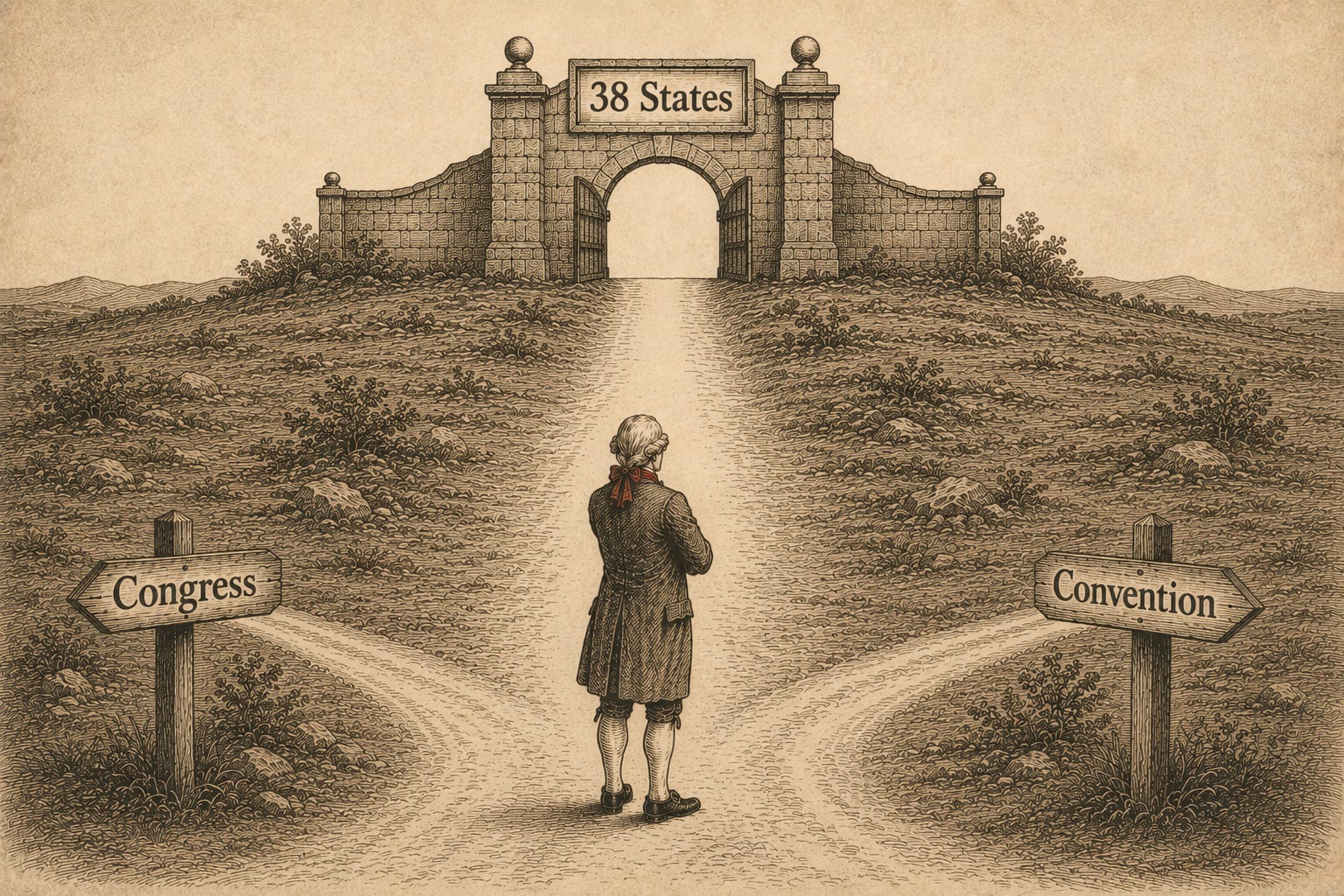
Look again at the first half of what he asked: Do you object to Article V itself, or only to the convention clause?
The two answers are not the same, and each one costs something. Let’s explore this deeper…
If the objection is to Article V entirely, then the objection is to the whole design the Founders built for changing the Constitution. That includes the congressional route you accept and the thirty-eight-state ratification wall you lean on every time you say a bad amendment could never pass. Reject Article V as a whole and you have not made the Constitution safer. You have made it nearly impossible to amend by any means except the ones history happens to have used. Few serious people will own that, because it is a position taken against the document itself.
If the objection is only to the convention clause, then, as one holding the anti-Article V stance, you must notice everything you have just conceded.
That amendments can be good.
That the super-majorities guard against bad ones.
That the bar is two-thirds of Congress to propose and three-fourths of the states to ratify.
That the states can be trusted with the most consequential decision in the entire process, the decision of what becomes supreme law.
All of it has been granted.
What remains is not a fear of amendment, or of super-majorities, or of the states. It is a fear of one mechanism.
So the serious worry was never that a convention would propose something monstrous and thirty-eight states would rush to enshrine it. The serious worry is about the assembly itself. A convention meets. It sets its own order of business. It builds its own momentum. And once it has, the fear runs, it might declare itself unbound, slip its instructions, and rewrite the rules of the game the way critics read the men at Philadelphia as having done in 1787.
Even I, a true supporter of Article V as a “fix”, must concede this is a real fear, and it is not a foolish one. It deserves to sit on the page without being swatted away.
But here is the distinction it misses. A convention’s power to set its own order of business is one thing. The rule for what becomes law is another, and the second lies entirely beyond the convention’s reach. How an assembly debates and votes is internal housekeeping. The ratification threshold is fixed in the text of the Constitution, outside the room, untouchable by anyone inside it. A convention can argue, posture, and overreach to its heart’s content, and not one word that it produces carries the force of law until three-fourths of the states agree. The wall the skeptic already trusts is the same wall standing at the only exit that matters.
Which brings me to the part of the record I find hardest to argue around, and believe me, I have looked.
The Framer most often cast as the convention route’s biggest doubter was James Madison. On September 15, 1787, as the Convention took up how the Constitution might one day be amended, Madison spoke. He also kept the most complete record of the Convention that survives, and like any careful reporter he set down every speaker in the third person, himself included. So when his journal records his own words that day, it reads this way: “Mr. MADISON did not see why Congress would not be as much bound to propose amendments applied for by two thirds of the States as to call a Convention on the like application.”
In plain terms, Madison saw the two routes as one obligation wearing two coats. Congress is no more and no less bound when the states demand a proposed amendment than when they demand a convention. Same duty. Two doors.
In the very next sentence, he went on: “He saw no objection however against providing for a Convention for the purpose of amendments, except only that difficulties might arise as to the form, the quorum &c. which in Constitutional regulations ought to be as much as possible avoided.”
Put plainly, his only hesitation about the convention route was procedural, the shape it would take and how many delegates must be present. Not its danger, but its housekeeping.
That is the man held up as the skeptic, treating the convention route as ordinary, parallel to the route his critics accept without a second thought, and finding in it nothing more troubling than the logistics of where to seat people and how many must show up.
The text of Article V says the rest in a single sentence.
So I will leave you where my acquaintance left me. If you trust the states to ratify an amendment proposed by Congress, you have already trusted the mechanism. The states are the wall on both paths. The same legislatures, the same three-fourths, the same power to refuse, standing guard whether the proposal came from the Capitol or from a convention the states themselves demanded.
The asymmetry was never written into the Constitution. It was only ever in us.
Ken Whaley @ Restore First Principles
Shawn, I appreciate the engagement, but your comments do not touch the question this post actually asks.
This post does not argue that proposal and ratification are identical. It argues that a convention's internal conduct carries no legal force, because nothing it produces becomes supreme law until three-fourths of the states ratify it, and that threshold sits in the text of Article V, beyond the reach of anyone in the room. You restate the proposal-versus-ratification distinction at length, but you never engage the wall itself, which is the entire load the post carries.
I would also note, for readers following along, that most of your comments are not new. The runaway-convention reading of 1787, the claim that no Founder counseled amendment when the Constitution is disobeyed, and the enforce-it-do-not-amend-it argument all appeared, nearly word for word, in your comments on "What the Framers Actually Built Into Article V." [https://restorefirstprinciples.substack.com/p/what-the-framers-actually-built-into]
My belief is that a repeated argument is not necessarily a stronger one. I would also add that more than once in this thread you have treated an unanswered comment as a concession. Silence in a comment section is not agreement, and it should not be characterized as one.
On the substance, two of your sourced points do not hold up the way they are presented.
The Kansas ruling you cite struck down that state's two-thirds requirement for submitting an Article V application. It concerned the legislature's power to apply for a convention. It did not address whether states may limit delegates, and it was decided in favor of the convention's supporters, not against them. [ https://caselaw.findlaw.com/court/us-dis-crt-d-kan/117911786.html ]
As for Federalist No. 40, it does not show Madison “confessing” a runaway. He wrote that the Convention's powers "were merely advisory and recommendatory" and that its plan was "of no more consequence than the paper on which it is written, unless it be stamped with the approbation of those to whom it is addressed." That states that the Convention's work carried no force until the people approved it, which is the very ratification wall this post describes. Madison then closed that essay by stating that "the charge against the convention of exceeding their powers, except in one instance little urged by the objectors, has no foundation to support it." [ https://avalon.law.yale.edu/18th_century/fed40.asp ]
The record is available to anyone who wants to read it and is why I always offer URLs in the posts and here in this comment.
KW
If you trust thirty-eight states to reject a bad amendment, why don't you trust those same states to participate in proposing one?
The fear of a "runaway convention" is understandable, but it overlooks a critical distinction. An Article V Convention can only propose amendments; it cannot ratify them. The real safeguard is, and always has been, the requirement that three-fourths of the states approve any amendment before it becomes law.
The Framers included the convention process because they understood that Congress might someday refuse to restrain itself. Article V gives the states a constitutional pathway to act when Washington will not.
Whether one supports or opposes a convention, the burden is to explain why the states can be trusted as the final guardians of the Constitution but not as participants in the amendment process itself. The Constitution places its faith in the states on both paths. Perhaps we should as well.